sorcery

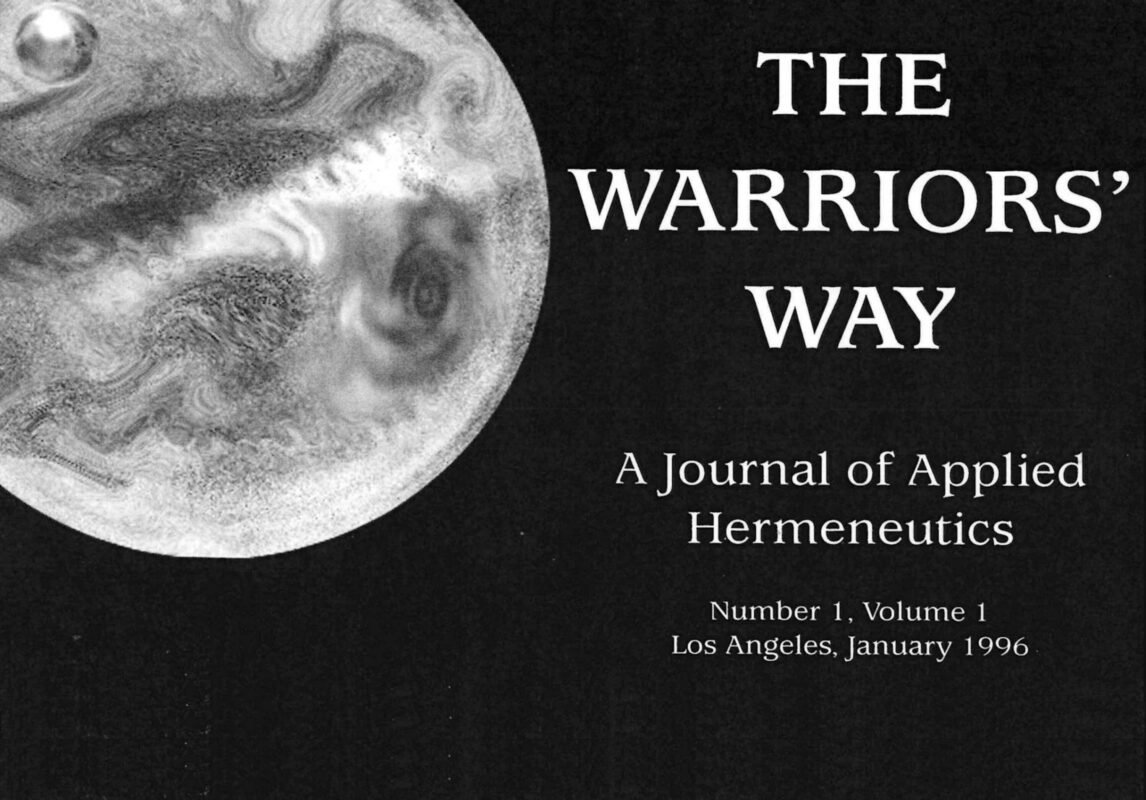
Journal of Applied Hermeneutics – A New Area for Philosophical Inquiry

Castaneda proposes a new area for philosophical inquiry based on two core concepts from ancient Mexican sorcerers: “seeing” and “intent”. He defines “seeing” as the human capacity to directly perceive energy as it flows in the universe, using the entire organism. “Intent” is described as a conscious, universal force that sorcerers can engage with through the act of “intending”. Castaneda argues that the direct perception of energy can create a new form of subjectivity, free from the limits of language, allowing for a pragmatic and active intentionality that could transform philosophy into a practical discipline.

Journal of Applied Hermeneutics – A New Area for Philosophical Inquiry Read More »

Journal of Applied Hermeneutics – How to do Tensegrity

Castaneda explains that the magical passes, the foundation of Tensegrity, should be practiced not as exercise but as a way of “beckoning power”. Don Juan taught that their “magic” is a “touch of the spirit” that connects one to the life force. Castaneda notes that the confusion felt by new practitioners from the sheer number of movements is a deliberate sorcerers’ device to “saturate” the mind and induce “inner silence”. From this state, a practitioner gains clarity and knows instinctively how to use the movements to continue what don Juan called humanity’s interrupted “journey of awareness”.

Journal of Applied Hermeneutics – How to do Tensegrity Read More »

Journal of Applied Hermeneutics – What is Hermeneutics?

In this section, Castaneda introduces the concept of hermeneutics, tracing its evolution from a method for interpreting sacred texts to a broader philosophical discipline concerned with interpreting the world. He then states the purpose of the journal: to apply these principles to the teachings of don Juan Matus, a Yaqui sorcerer. Castaneda’s aim is to focus on the practical application of don Juan’s interpretive framework, hence the name “applied hermeneutics,” which emphasizes a sorcerer’s practicality over abstract philosophical reflection.

Journal of Applied Hermeneutics – What is Hermeneutics? Read More »

Journal of Applied Hermeneutics – The First Principle of the Warrior’s Way: We Are Perceptors

Here, Castaneda introduces the first premise of the warriors’ way as taught by don Juan Matus: “We Are Perceptors”. He explains that while this seems obvious, it is a profound statement for sorcerers, highlighting that humanity’s basic orientation is perceiving. According to don Juan, humans interpret a minimal influx of energy through a system called the “human form,” creating a world that is mostly interpretation rather than direct perception. The premise is thus a call from sorcerers to return to humanity’s original state of direct perceiving.

Journal of Applied Hermeneutics – The First Principle of the Warrior’s Way: We Are Perceptors Read More »

Journal of Applied Hermeneutics – What is Tensegrity?

Castaneda explains Tensegrity’s origins as a modernized version of “magical passes” from don Juan Matus’s lineage. He recounts don Juan’s teachings about ancient sorcerers who could perceive energy directly (‘seeing’), which revealed the human ‘assemblage point’ where perception is assembled. By studying this point’s movement, they developed the ‘art of dreaming’ and the magical passes. Castaneda notes that after learning these passes in secret, he and his fellow disciples decided to make them public as Tensegrity, a name signifying the tension and integrity that are the driving forces of the movements.

Journal of Applied Hermeneutics – What is Tensegrity? Read More »

Journal of Applied Hermeneutics – What is Intentionality?

Castaneda begins with a note on his use of language before exploring “intentionality,” seeking to move beyond standard philosophy. He traces the term from the medieval Scholastics to the 19th-century philosopher Franz Brentano, who defined it as the unique characteristic of mental phenomena to be directed toward an object. Castaneda then connects this to the sorcery concept of “calling intent”. From a sorcerer’s perspective, he explains, intent is not a mental product but a tangible, energetic force that exists outside the physical body and can be engaged with.

Journal of Applied Hermeneutics – What is Intentionality? Read More »

Silent Knowledge – The Magical Passes

In this chapter, Castaneda recounts his first in-depth discussion with don Juan Matus about the “magical passes,” which began with a criticism of his physical condition. Don Juan reveals he had been teaching Castaneda the passes all along, disguised as his habit of “cracking his joints.” He explains that these movements are not mere exercises but are truly “magical” because they can halt the mind’s normal “lines of similarity” and interrupt the mundane flow of reality, which is perceived as fixed and unchangeable. Don Juan also makes the startling claim that the mind is a “foreign installation” and that the passes help to overcome its influence. He reveals that the origin of the passes lies in the *dreaming* practices of ancient sorcerers, who discovered them as a way to recreate states of well-being and prepare for their “navigations into the unknown.”

Silent Knowledge – The Magical Passes Read More »

Silent Knowledge – The Center for Decisions

In this chapter, Castaneda explores the second topic of interest for the ancient sorcerers: “the center for decisions,” located in the “v” spot at the base of the neck. Don Juan explained that this is one of six main energy vortexes in the body, but its specific, fluid-like energy is displaced early in life, resulting in the human inability to make decisions. He also reveals the sorcerers’ view of the center at the top of the head, which they believe has been taken over by a “foreign installation”—the mind. The magical passes, or modern Tensegrity, serve to strengthen the other five centers by redistributing energy that has been scattered to the edges of a person’s luminous being. This redistribution of energy, especially to the center for decisions, restores the capacity to decide and overall vitality, overcoming the indecisiveness and exhaustion caused by the wear and tear of daily life.

Silent Knowledge – The Center for Decisions Read More »

Silent Knowledge – The Recapitulation

In this chapter, Castaneda details the third pillar of sorcery practice: the “Recapitulation.” He describes it as a procedure for reliving one’s entire life with two main goals. The first is cosmological: to satisfy a universal force called “the Eagle,” which seeks a being’s life experiences, not its life force. By offering a detailed account of their lives, sorcerers can retain their life force at the moment of death and embark on a journey of perception as inorganic beings. The second goal is pragmatic: to acquire “perceptual fluidity.” Reliving memories forces the “assemblage point” to shift to its past positions, and this repetitive movement grants the practitioner the flexibility needed to face the unknown. Castaneda also describes the practical method taught by don Juan: making a list of all known persons and using a specific breathing technique to inhale recovered energy and exhale unwanted feelings associated with each memory.

Silent Knowledge – The Recapitulation Read More »

Silent Knowledge – Dreaming

In this chapter, Castaneda explores the “art of dreaming,” which he defines as the sorcerers’ technique for breaking the parameters of normal perception to travel into the unknown. Don Juan explains that sorcerers’ dreaming (*ensoñar*) is different from ordinary dreaming (*soñar*) and is based on the deliberate displacement of the “assemblage point” from its usual position. This practice originated from the ancient sorcerers’ observation that the assemblage point moves naturally during sleep. The key to this art is the development of “dreaming attention,” a focused awareness that allows the practitioner to control the dream state and enter other real, energy-generating worlds. The art of dreaming is complemented by the “art of stalking,” which is the ability to hold the assemblage point fixed in its new position, allowing for a full exploration of these other realms.

Silent Knowledge – Dreaming Read More »

Translate »