
Ancient Cycle

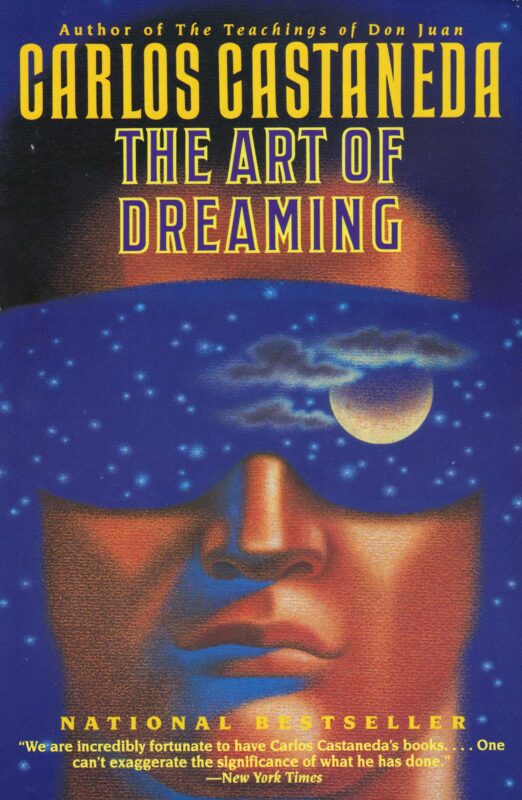
The Tenant – The Art of Dreaming

In this chapter, don Juan Matus informs Carlos Castaneda that his formal instruction in dreaming is over, but he must outline the fourth gate of dreaming. He takes Castaneda to a town in southern Mexico for a final lesson, which is to be delivered by a mysterious visitor. This visitor is revealed to be the “tenant,” an ancient sorcerer also known as the death defier. Castaneda is overcome with panic and revulsion when he discovers the tenant, who he had previously met as a man, is now a woman. Don Juan explains that for such a powerful sorcerer, gender is a matter of choice, achieved by shifting the assemblage point. Castaneda must now face the tenant alone to make a decision about accepting or rejecting the tenant’s “gifts of power,” a choice that every nagual in their lineage has had to make.
The Tenant – The Art of Dreaming Read More »

The Woman in the Church – The Art of Dreaming

After being left by don Juan, Carlos Castaneda kneels in the church next to the death defier, an ancient sorcerer who appears as a woman. Initially terrified, he is mesmerized by her voice and presence. He offers her his energy freely but refuses her obligatory “gifts of power.” The woman then pulls him into the second attention, revealing the church and town as they existed in a different time, a product of her own intent. She explains the sorcerers’ art of creating veritable realms in dreaming through visualization and the technique of “twin positions.” Castaneda explores this tangible dream world with her, learning that only she generates energy within it. The experience culminates in a terrifying realization that their current reality might also be a shared dream, causing him to lose consciousness in a spinning descent into blackness.

The Woman in the Church – The Art of Dreaming Read More »

Flying on the Wings of Intent – The Art of Dreaming

After a prolonged encounter with the death defier, Carlos Castaneda awakens to find his fellow apprentice, Carol Tiggs, caring for him. Disoriented and partially paralyzed, he learns from her that he is in a hotel after being found naked near the church. Carol, displaying a new lucidity, explains that they are both intending in the second attention, a gift from the death defier that allows them to dream themselves into another time. Castaneda is consumed by affection for her but is soon pulled into a vortex. He later awakens alone and discovers from a distraught don Juan that he has been missing for nine days and that the real Carol Tiggs was never there. Don Juan deduces that the death defier used her own energy and Castaneda’s to create a “dream Carol” of pure intent, and that both the real Carol and the death defier have now merged and escaped this world, flying on the “wings of intent”—an abstract gift and a fate now shared with Castaneda.

Flying on the Wings of Intent – The Art of Dreaming Read More »

Author’s Note – The Art of Dreaming

In this introductory note, Carlos Castaneda clarifies his use of the term “sorcery” to describe the teachings of his mentor, don Juan Matus, distinguishing it from conventional definitions. He explains that for don Juan, sorcery is about manipulating perception to access other real worlds, a practice called “the art of dreaming.” Castaneda recounts his own experiences learning this art, his interactions with two distinct groups of apprentices, and the challenges of reconciling his experiences in the “second attention” with everyday reality. He states that the purpose of this book is to rearrange and present don Juan’s lessons on dreaming in a linear fashion, made possible by years of dedicated practice, and to ultimately explain the legacy don Juan left to his final students as an act of gratitude.

Author’s Note – The Art of Dreaming Read More »

Sorcerers of antiquity: an introduction – The Art of Dreaming

In this chapter, Carlos Castaneda recounts don Juan’s explanation of the foundational principles of sorcery, established by brilliant but obsessive “sorcerers of antiquity.” Don Juan contrasts their focus on concrete power with modern sorcerers’ search for abstract freedom. The core discovery of the ancients was the ability to perceive energy directly, which they called “seeing.” This led to the identification of the human energy form as a “luminous egg” and its crucial feature: the “assemblage point,” a spot of brilliance that assembles filaments of universal energy into our perception of the world. Castaneda learns that displacing this point—either as a “shift” within the luminous egg or a “movement” outside of it—is the key to perceiving other worlds and is the basis for the “second attention” and the art of “dreaming,” which is defined as the willful displacement of the assemblage point during sleep.

Sorcerers of antiquity: an introduction – The Art of Dreaming Read More »

Delia talks about women’s silent slavery

An intense dialogue between Delia and Florinda takes place as they travel by car. The conversation begins with Delia’s admiration for the Yaqui warriors, quickly evolving into a philosophical discussion about the different types of war and freedom. Delia then expounds on the idea that women are, because of their feminine condition and sexuality, slaves to men, even in modern society.

Delia talks about women’s silent slavery Read More »

Journal of Applied Hermeneutics – Queries about the Warriors’ Way: The path without a teacher, Carlos’ plan, and Tensegrity

Carlos Castaneda addresses common inquiries about his role and the nature of Tensegrity and the warriors’ way. He clarifies that he sees himself as a counselor, aiming to guide others towards freedom from a “sight from the bridge” — a state of total silence where one perceives the present without the biases of the past or future. He emphasizes that the path is not about following a personal guru, as don Juan himself was a sorcerer perpetuating a lineage, not a teacher in the conventional sense. Instead, the true guide is the impersonal spirit or life force, accessible through inner silence. Castaneda explains that Tensegrity is a modernized system of “magical passes” — movements developed by ancient Mexican shamans to directly perceive energy — which were kept secret until now, as don Juan’s lineage concludes with his four disciples, freeing them to share this knowledge for the benefit of all, promoting well-being and breaking free from the constraints of everyday perception and self-importance.

Journal of Applied Hermeneutics – Queries about the Warriors’ Way: The path without a teacher, Carlos’ plan, and Tensegrity Read More »

Journal of Applied Hermeneutics – Queries about the Warriors’ Way: What is the point of doing all those Practices?

In this section, Castaneda addresses two common questions. The first concerns when a practitioner will achieve “seeing,” the direct perception of energy. He explains that while practices are important, the crucial element is to “intend” the outcome—the state sorcerers call “stopping the world,” which is achieved by obliterating self-importance. The second question is about fear over strange physical sensations during Tensegrity. Castaneda recounts how don Juan Matus explained such feelings not as external manipulation, but as natural physiological responses or a product of one’s own victim mentality. Don Juan’s advice was to counter fear by being “impeccable”.

Journal of Applied Hermeneutics – Queries about the Warriors’ Way: What is the point of doing all those Practices? Read More »

Journal of Applied Hermeutics – Fourth Principle of the Warrior’s Way: The Energy Body

The fourth unit of the warriors’ way is THE ENERGY BODY Don Juan Matus explained that, since time immemorial, sorcerers have given the name of energy body to a special configuration of energy which belongs to each human being individually.

Journal of Applied Hermeutics – Fourth Principle of the Warrior’s Way: The Energy Body Read More »

Translate »